
From Bulk Print and Manual Kitting to Store-Specific, Route-Optimised Production
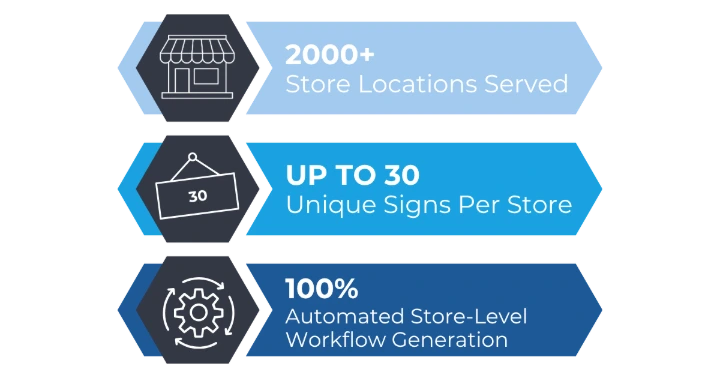
A large multi-location retail organisation undertaking a nationwide store refresh needed to deliver customised signage kits to more than 2,000 locations across the country. The project involved up to 30 unique sign designs per store, with each location requiring a different combination based on store format, layout, and regional requirements.
To support the rollout, Innovaic designed and implemented a fully automated production workflow using Enfocus Switch, Enfocus Phoenix, and Enfocus PitStop - replacing a highly manual process that was creating bottlenecks across printing, kitting, and shipping.
Overview
The retailer’s existing workflow relied on a bulk-print production model. Teams would first calculate the total quantity required for each sign type across all stores, print every version in large batches, and then send the completed output to a manual kitting department for sorting and assembly.
At scale, the process became increasingly difficult to manage. Every store required a different combination of signage, meaning kitting staff had to manually cross-reference store requirements while sorting thousands of printed pieces into individual packages.
Innovaic developed a fully automated workflow that shifted production away from bulk sign printing and reorganised the entire process around individual store jobs. Each store became its own automated production package - complete with matched signage, paperwork, labels, and shipping logic.
The Challenge
The original workflow created several operational bottlenecks that affected throughput, accuracy, and shipping efficiency.
Print Dependency Bottlenecks
All sign variations had to complete printing before kitting could begin, creating a hard dependency between departments and slowing overall production flow.
Manual Kitting Complexity
Kitting teams were required to manually identify, sort, and assemble signage for every individual location using spreadsheets and printed references - a slow and error-prone process when managing thousands of pieces.
Rework and Missing Components
Mismatched or missing signage often went unnoticed until final kit assembly, resulting in additional manual verification, reprints, and shipping delays.
Inefficient Shipping Coordination
Because jobs were produced as one undifferentiated batch, outbound shipping could not be optimised by region or delivery route.
Scale and Operational Risk
With more than 2,000 stores and potentially 60,000+ individual printed pieces, the process became operationally unsustainable without automation.
The Solution
Innovaic designed and implemented a fully automated, store-driven production workflow using Enfocus Switch, Enfocus Phoenix, and Enfocus PitStop.
Rather than organising production around sign types, the workflow treated each store as its own discrete production job - enabling printing, kitting, and shipping to operate in parallel rather than sequentially.
Spreadsheet-Driven Job Generation
The workflow ingested a master spreadsheet containing each store’s specific signage requirements.
Enfocus Switch automatically parsed the data and generated a separate, fully defined print job for every individual store. Each job contained only the signage required for that location, eliminating manual interpretation and downstream sorting.
Automated File Preparation with Phoenix and PitStop
Enfocus Phoenix handled dynamic asset selection and layout construction, automatically assembling store-specific print packages from the master artwork files.
Enfocus PitStop automated preflight, file conditioning, paperwork generation, and store-level labeling to ensure every output met production specifications before reaching the press.
Store-Level Labeling and Matched Documentation
Every output file was automatically labeled with its corresponding store identifier.
The workflow simultaneously generated matching paperwork, including packing slips, job tickets, and assembly instructions, ensuring every store package moved through production with complete traceability and minimal manual handling.
By the time jobs reached the kitting department, staff could assemble and package output immediately without additional verification or cross-referencing.
Route-Optimised Shipping and Production Sequencing
Regional delivery routes and outbound truck groupings were pre-defined within the workflow data.
The system automatically grouped and sequenced production by shipping route, allowing completed jobs to move directly into staging and outbound loading as production continued.
Instead of waiting for the full production run to complete, shipments could be processed continuously throughout the project lifecycle.
Results & Impact
Printing
Jobs were produced store-by-store rather than in undifferentiated bulk runs. Press operators worked from clearly defined, sequenced jobs with no ambiguity about what was being produced or for whom.
Kitting
Manual sorting was eliminated. Each completed print job arrived in the kitting area already labeled and paired with its paperwork. Staff assembled kits directly from job output without any cross-referencing.
Shipping
Regional batching by truck route allowed finished kits to be staged and loaded continuously throughout production rather than waiting for all jobs to complete. Outbound shipments were more organized and carrier-coordinated.
Overall Throughput
Removing the hard dependency between printing and kitting meant work could flow through the facility in parallel. Earlier-completing store jobs moved toward shipping while remaining print jobs were still running.
Accuracy
Store-specific labeling and auto-generated matching paperwork eliminated the manual cross-referencing that had been a primary source of kitting errors.
Technology Stack
Enfocus Switch
Core workflow automation engine - orchestrated all routing, job generation, file movement, and output logic.
Enfocus Phoenix
Dynamic asset selection and job construction - assembled store-specific print packages from master sign files.
Enfocus PitStop
Automated PDF preflight and conditioning - ensured all files met press specifications without manual prepress.
Spreadsheet Input
Master data source defining each store’s unique sign requirements, consumed and parsed automatically by the workflow.
By restructuring production around individual store jobs rather than bulk sign types, the workflow removed one of the most persistent constraints in large-scale print fulfilment - the dependency between printing, kitting, and shipping.
What had previously been a sequential, manual process became a continuous, parallel operation where work could move through the facility as soon as it was produced. This shift not only improved throughput and accuracy, but also created a more controlled and predictable production environment at scale.